
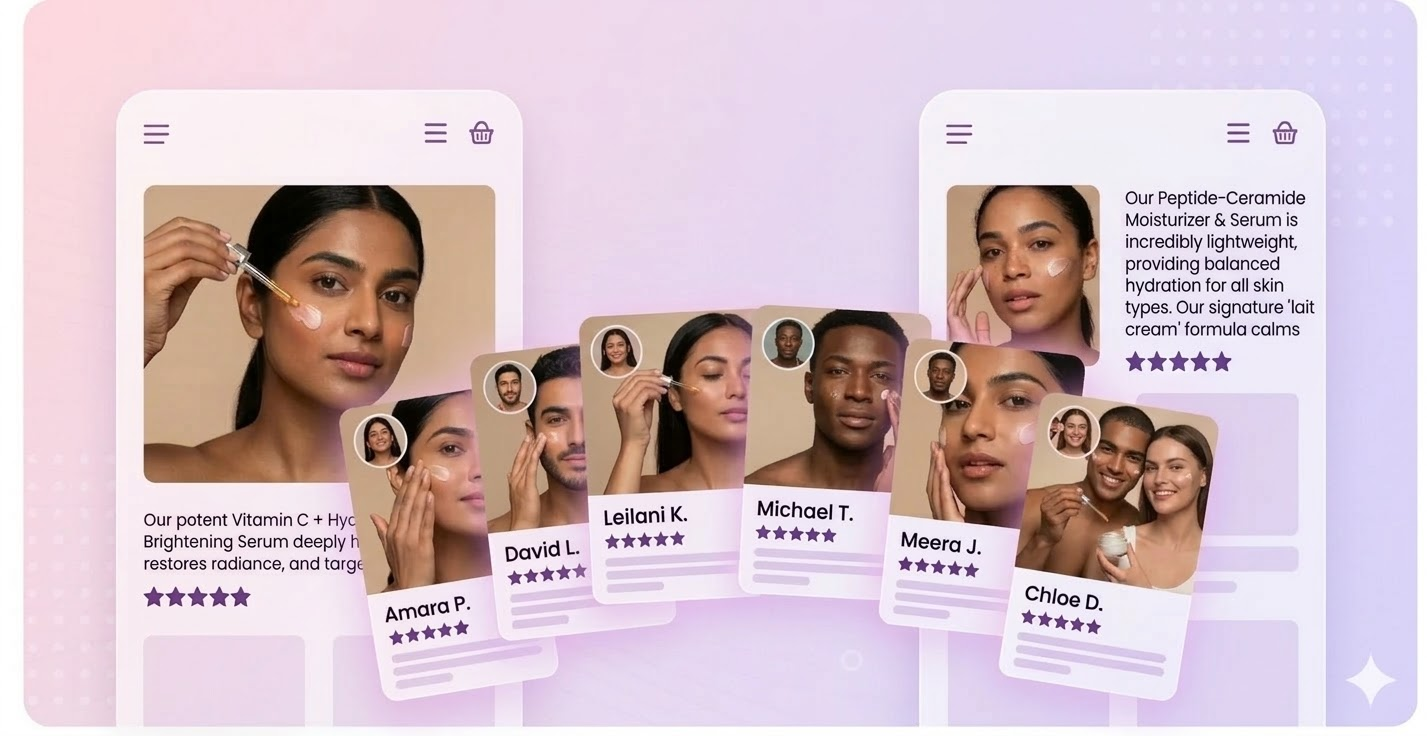
You launched your store. You are running ads. Buyers are landing on your product page. And then... they leave. You check everything. The product looks fine. The price is competitive. The creative is decent.
But there are three reviews on your page. Two are from six months ago. One is just one star with no text.
That is the problem. And it is a bigger one than most Indian D2C founders realise.
- 48% of Indian shoppers abandon carts because reviews are absent or too few
- 270% conversion lift possible with just 5 genuine product reviews (Spiegel Research)
- 92% of first-time buyers read reviews before purchasing from a new brand
Reviews are not just a nice-to-have. For Indian and UAE D2C brands running paid ads, they are the single biggest difference between a store that converts at 0.8% and one that converts at 2.5%.
Here are 9 methods that actually work. Some take 10 minutes to set up. Some are strategies your competitors have not thought of yet.
The 9 Methods
01. Collect Customer Reviews via WhatsApp, Not Just Email
If you are only sending review request emails, you are leaving most of your reviews on the table. Email open rates for Indian D2C brands hover around 20–25%. WhatsApp open rates? Closer to 90%. Response rates on WhatsApp review requests are 25–40% compared to 5–8% for email.
A brand doing 200 orders a month can go from collecting 10–15 reviews to 50–80, just by switching channels. The message does not need to be fancy. "Hi Priya, loved that you ordered our sunscreen. Did it work for you? A quick review would mean the world to us" is enough.
Quick tip: In India, people are on WhatsApp all day. They check it before they check their email. If your review request is sitting in an inbox, it is probably buried under promotional tabs. Send it on WhatsApp.
02. Offer Incentives for Photo and Video Reviews
Text reviews are good. Photo reviews are 3x better at converting first-time buyers. A buyer in Mumbai or Dubai who sees a real person who looks like them using a product is far more likely to buy than someone reading "great product, fast delivery."
Offer a small incentive exclusively for photo or video reviews: a 10% discount on their next order, an extra product sample, or early access to a sale. Make it clear in the review request: "Share a photo with your review and we will send you something."
Quick tip: Keep the incentive for photos only, not just any review. This filters for the content that actually moves your conversion rate.
03. Time Your Review Request 7–10 Days After Delivery, Not the Day After
Most brands send their review request the day after the order ships. The product has not even arrived yet. Worse, they send it the day after delivery, when the buyer has barely opened the package.
Wait 7–10 days. By then, the buyer has actually used the product. They have an opinion. For skincare brands, 2 weeks is even better, because that is when results start showing. A review written after real use is more specific, more emotional, and more useful to the next buyer.
Quick tip: For Indian skincare, ayurvedic, and supplement brands in particular: 14 days is the sweet spot. Buyers say things like "I can actually see a difference" which is exactly what your next customer needs to hear.
04. Include a QR Code Inside Your Product Packaging
Your packaging is already in the buyer's hands. Use it. A small card inside the box that says "Loved it? Scan to leave a quick review" with a QR code pointing to your review page takes five minutes to design and costs almost nothing to print.
This is especially powerful for brands shipping to Tier-2 and Tier-3 cities in India, where email engagement is lower but buyers are happy to scan a QR code on their phone. The moment of unboxing is peak delight, and that is the best time to ask.
Quick tip: Test two versions of the card: one with "share a photo" language, and one without. You will almost certainly find the photo-specific one generates better reviews.
05. Aggregate Reviews from Amazon, Myntra, and Quick Commerce onto Your Shopify Store
Here is something most D2C founders do not think about: your buyers are leaving reviews on Amazon, Myntra, Blinkit, Zepto, and Nykaa. Meanwhile, your Shopify store has almost none.
You can pull all those reviews together and surface them on your own product page, so a buyer who lands on your D2C store does not have to go hunting across platforms to check if the product is real. Everything is right there.
This is one of the fastest ways to go from three reviews to three hundred, without waiting for new orders.
Quick tip: For brands already selling on marketplaces, this is the single fastest trust-building move. You have the reviews. They are just not in the right place.
06. Run a Structured Sampling Campaign Before Your Product Launch
Every new product launch starts at zero reviews. That is brutal, because buyers do not trust products with no social proof, even if the product is excellent.
Before you launch publicly, send samples to 20–30 real buyers from your existing customer base. These are people who have already bought from you and trust your brand. Ask them to use the product for a week and leave an honest review. By the time you run your first ad for the new product, you already have 15–20 real, verified reviews waiting.
Quick tip: Pick buyers from different cities and age groups for your sampling list. Reviews from "Ananya, 28, Bangalore" and "Meera, 42, Surat" tell a more complete story than five reviews from the same demographic.
07. Add a Scrollable Video Review Widget to Your Product Page
Text reviews tell buyers what people think. Video reviews show them. A 15–30 second clip of a real customer using your product does more trust-building work than 40 written reviews.
For Indian and UAE buyers in particular, video proof from someone who looks like them, has a similar skin tone, similar lifestyle, similar concern, is enormously persuasive. It answers the question they are all silently asking: "Has someone like me actually used this?"
Quick tip: Scrollable video widgets on the PDP (not buried in a separate tab) increase time on page and reduce bounce rate. Both help your Meta ad conversion rate directly.
08. Add an AI Review Summary Near Your Buy Button
This is a display method, not a collection method, but it is just as important. Once you have reviews, most buyers do not read all of them. They scan. They want the takeaway fast.
An AI-generated summary sitting right above or below your Add to Cart button, something like "Buyers say: no white cast, gentle on sensitive skin, visible difference in 2 weeks" does the job in three seconds. It respects the buyer's time and keeps them on the page instead of scrolling away.
Quick tip: The summary format works especially well for product categories where specificity matters: skincare (skin tone, sensitivity), fashion (fit, fabric feel), supplements (results timeline, taste).
09. Pull Your Instagram UGC and Media onto Your Product Page
Your customers are already talking about you on Instagram. They are tagging your brand in stories, posts, and reels. That is social proof sitting outside your store, invisible to the buyers who matter most.
Building a media gallery on your PDP that pulls in Instagram tags, brand community screenshots, and even offline expo content puts all of it in one place. A buyer who sees real people interacting with your brand in the real world feels an entirely different level of confidence.
Quick tip: For UAE brands in particular, showing real customers from Dubai, Abu Dhabi, and the wider GCC region in your gallery makes a significant difference. UAE buyers trust brands that feel locally relevant, not globally generic.
India and UAE context
In India, WhatsApp is where trust is built. COD is still 40%+ of D2C orders, which means buyers are already cautious. Reviews from people who look and sound like them, written in relatable language, are the single most effective trust signal available. In the UAE, where buyers compare your D2C store against Amazon UAE and Noon in the same browsing session, having more verified reviews than those platforms on your own site is a genuine competitive advantage. Neither market is won by having the lowest price. Both are won by having the most visible proof that real people trust your product.
The placement rule nobody talks about
Getting reviews is only half the job. Where you put them matters just as much. Reviews buried at the bottom of the page have almost no impact on conversion. Reviews placed next to the buy button, with an AI summary above them and photo or video proof alongside them, can lift your conversion rate by 25–35% without changing anything else on the page.
Quick summary: what to do first
- Switch your review request channel from email to WhatsApp for your next 50 orders. Track the response rate.
- Change your review request timing to 7–10 days post-delivery, not the day after shipping.
- Add a QR code to your packaging that goes straight to your review page.
- Check how many reviews you have on Amazon, Myntra, or Blinkit. Start aggregating them onto your Shopify PDP.
- For your next product launch, sample to 20 existing customers before the public launch.
- Move your reviews to sit right next to the buy button. Not at the bottom of the page.
- Add an AI summary above your review section that tells buyers the headline in 3 lines.
A store with 5 genuine reviews converts up to 270% better than a store with none. But a store that places those reviews in the wrong location gets almost none of that benefit. The what and the where both matter.
About Word of Mouth
Word of Mouth (thewordofmouth.tech) is an AI-powered conversion trust engine for D2C eCommerce brands in India and the UAE. We deploy a 5-layer trust system across brand websites, covering Confidence, Clarity, Safety, Comfort, and Credibility, to convert hesitant browsers into buyers without increasing ad spend. We work with 100+ D2C brands across fashion, beauty, fitness, F&B, and more.